Let’s hack minesweeper
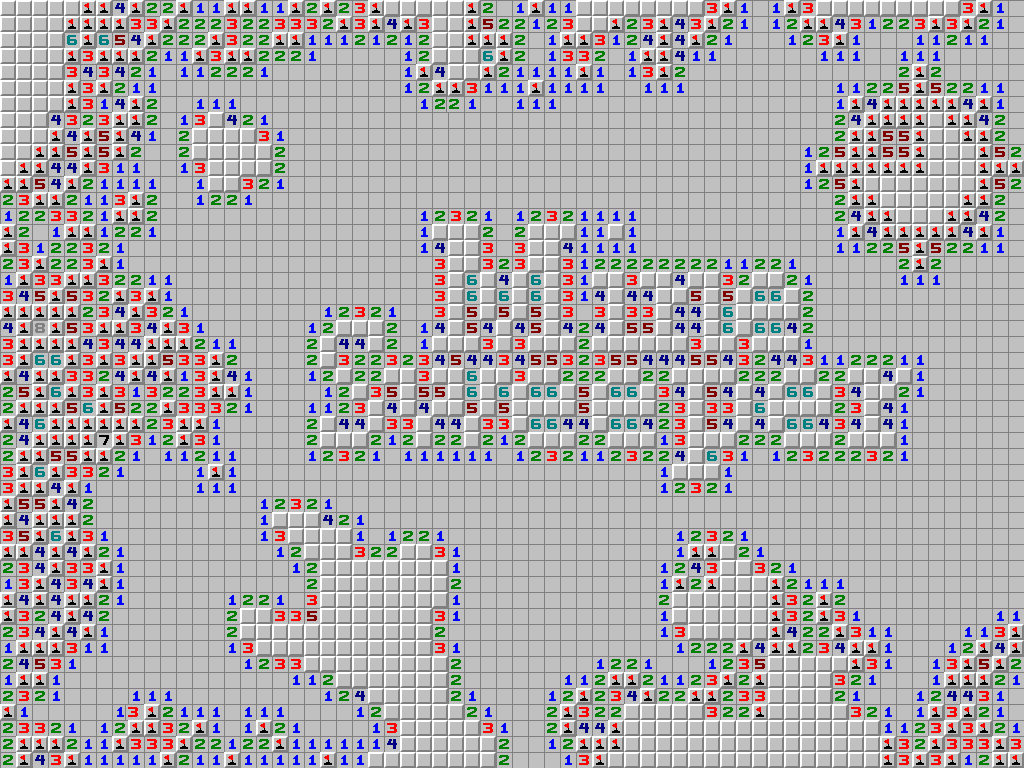
Remember the old days when you didn’t have any internet but still wanted to play something on the computer? Such as chess, cake cooking and so on.
And then, there was a shitty nerve cracking game called minesweeper. You were supposed to blindly choose a cell and hope that it won’t explode. And of course, there was this “smile emoji” mf who did absolutely no help to win the game.
I was not able to win that game, even now I just can’t. Then I realized, why I don’t apply RE skills in here and decided to write this absolutely useless blogpost.
PS: There are lots of minesweeper reversing blogposts as well, therefore this post will only show my experience and difficulties that I have faced, don’t consider this as a study material.
Hope you will enjoy.
I am going to use Ghidra in order to disassemble / decompile the source code and x32dbg for debugging purposes. In here, function names will be random as my PDB is causing problems (google PDB).
We know 2 things. This game is 2D board, we should expect something like this. And, this game is randomized, meaning that every time there the mines and the flags will be in different places. At this point, there should be random function. Let’s go for it.
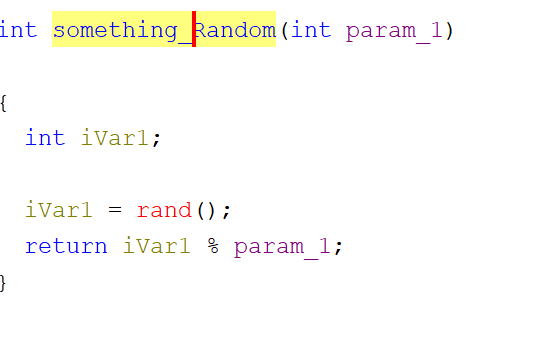
Search for rand keyword in full codebase, and you will see 2 random functions, rand and srand. first, we will first start with rand. something_random is function name that is renamed by me. As it is shown in here, this function is taking parameter and divides the random value with that parameter.
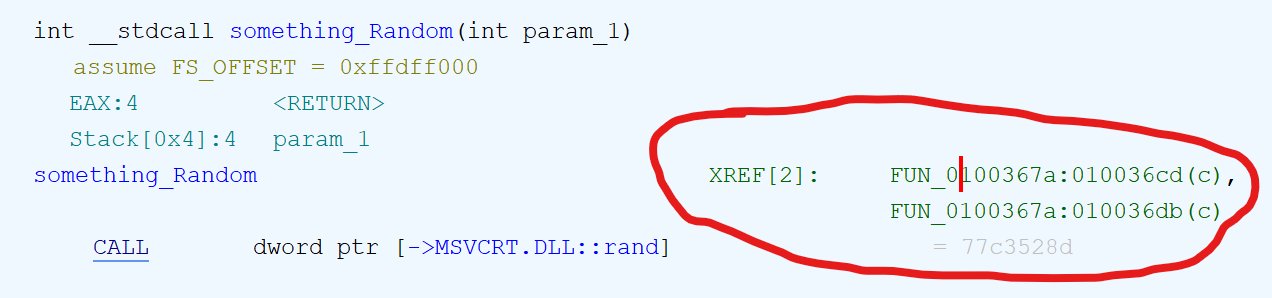
Check the function in which the something_random is referenced.
Referenced function is like this:
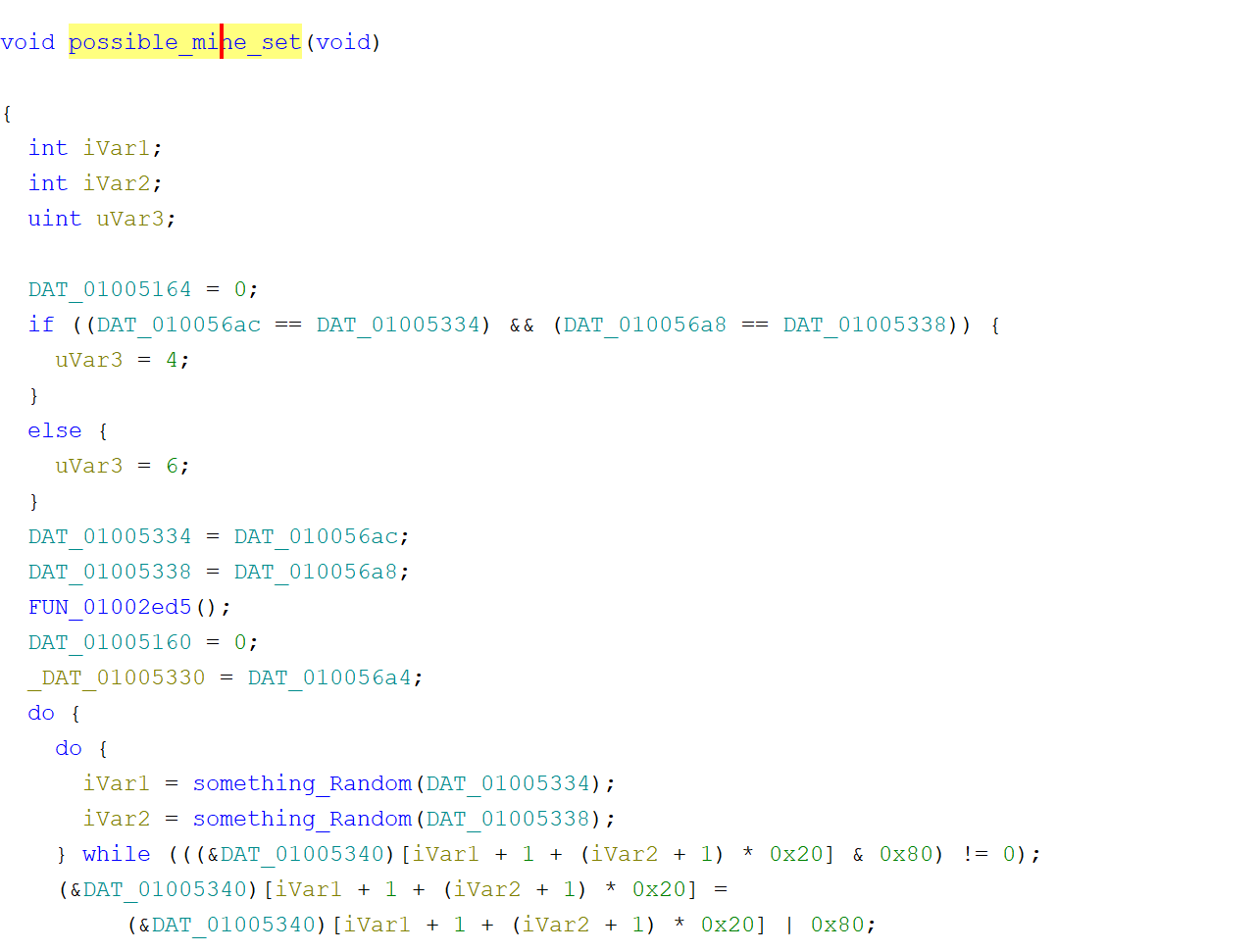
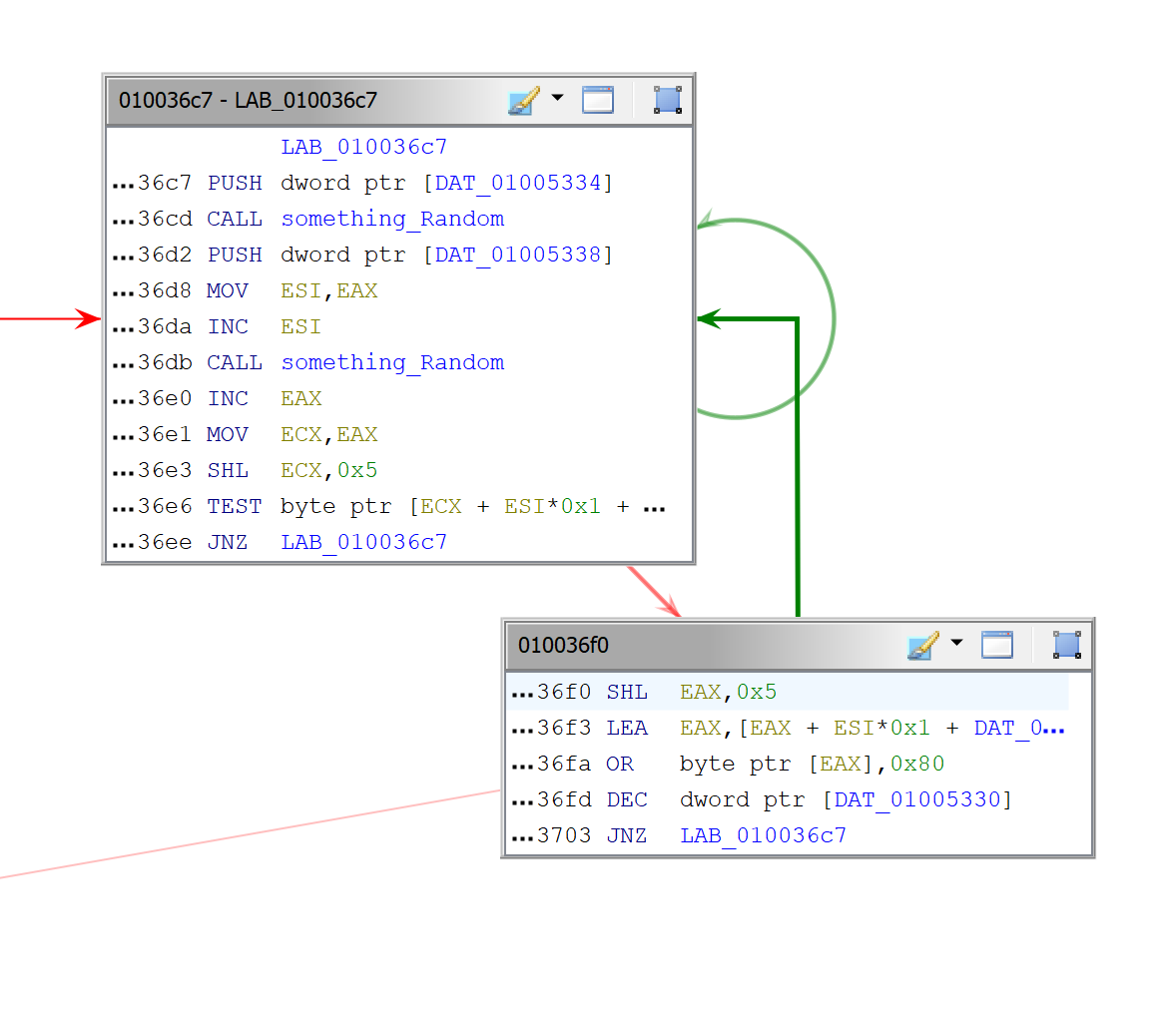
iVar1 --> random_value / DAT_..5334
iVar2 --> random_value / DAT_..5338

DAT_01005340 is the pointer to the start of the game board array.
[iVar1 + 1 + (iVar2 + 1) * 32] --> coordinate of one tile
You may ask why it is being multiplied with 32, well the game is 32x32 pixels, thats why.
while loop checks if the tile is being set as a mined or not. If mined,
it will keep looping, if not, it will make it mined by setting LSB. And this
is done by making OR operation with 0x80.
To understand this better, lets add breakpoints to each of the something_random call and see the values.
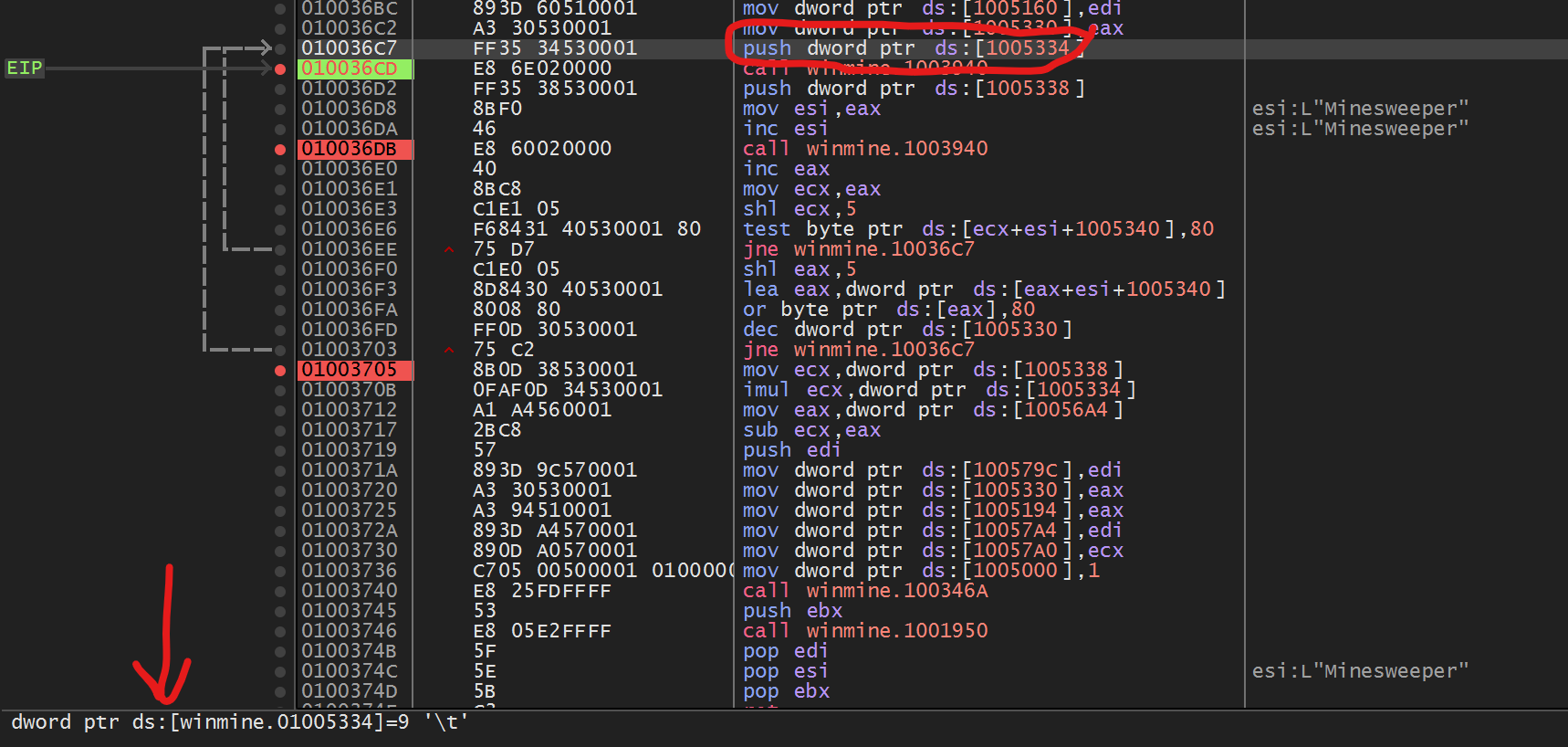
We see the value that is being pushed to the stack and used as a parameter on the something_random function. in both cases, we will get something like this:
ivar1 = random_value / 9
ivar2 = random_value / 9
I am guessing that 9 is because of our game scale. It is 9x9 if you remember.
After that, we will see that it goes through the loop 10 times and possibly adds the mines. These mines are being added starting from this address: DAT_01005340.
At this point, the logic that I have explained before, starts to execute. if the value is 0x0f, it will convert it to 0x8f my doing OR operation with 0x80.
Meaning that there is high possibility that if we look for DAT_01005340, we will the hex presentation of the game board.
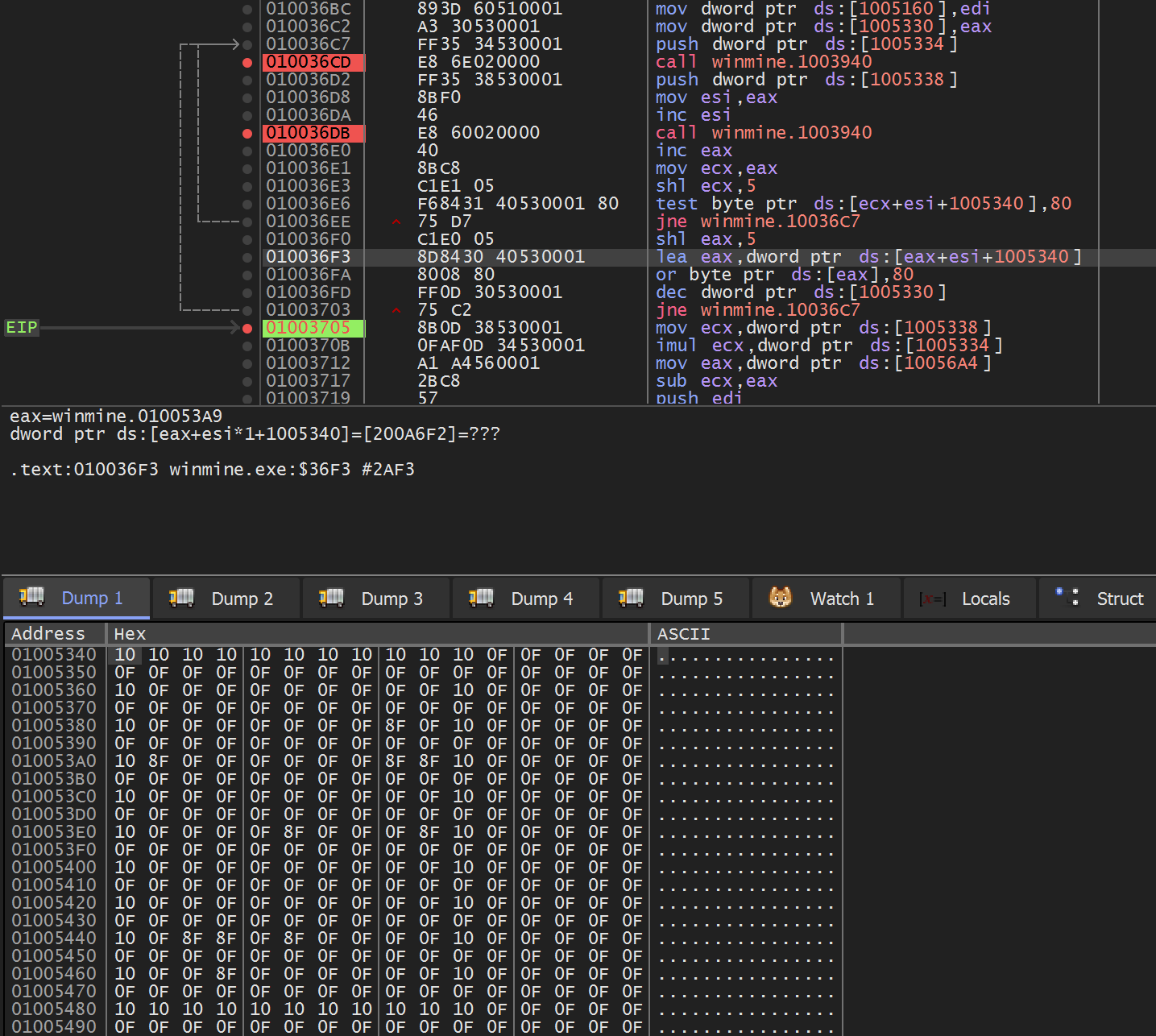
I continued to run the code, and it started to loop ten times between the first two breakpoints and then goes to the last breakpoint. This means, our mines have been set.
0x0F and 0x10 — will be side borders and empty parts (delimiters “\t”)
0x0E — if we flag
0x0D — if we question
0x8F — will be mine locations
0x8E — if we flag
0x8D — if we question
We can easily check it.
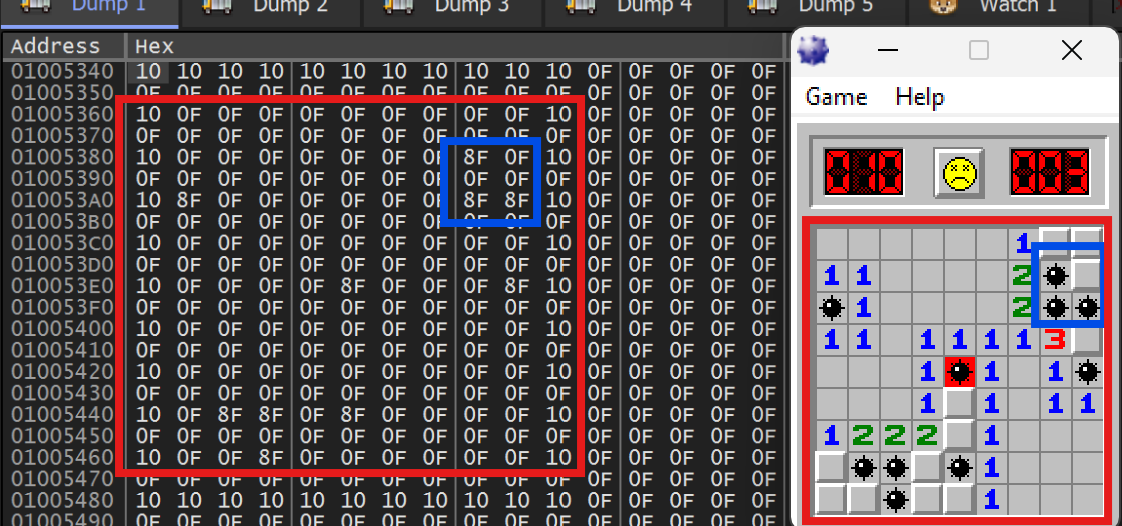
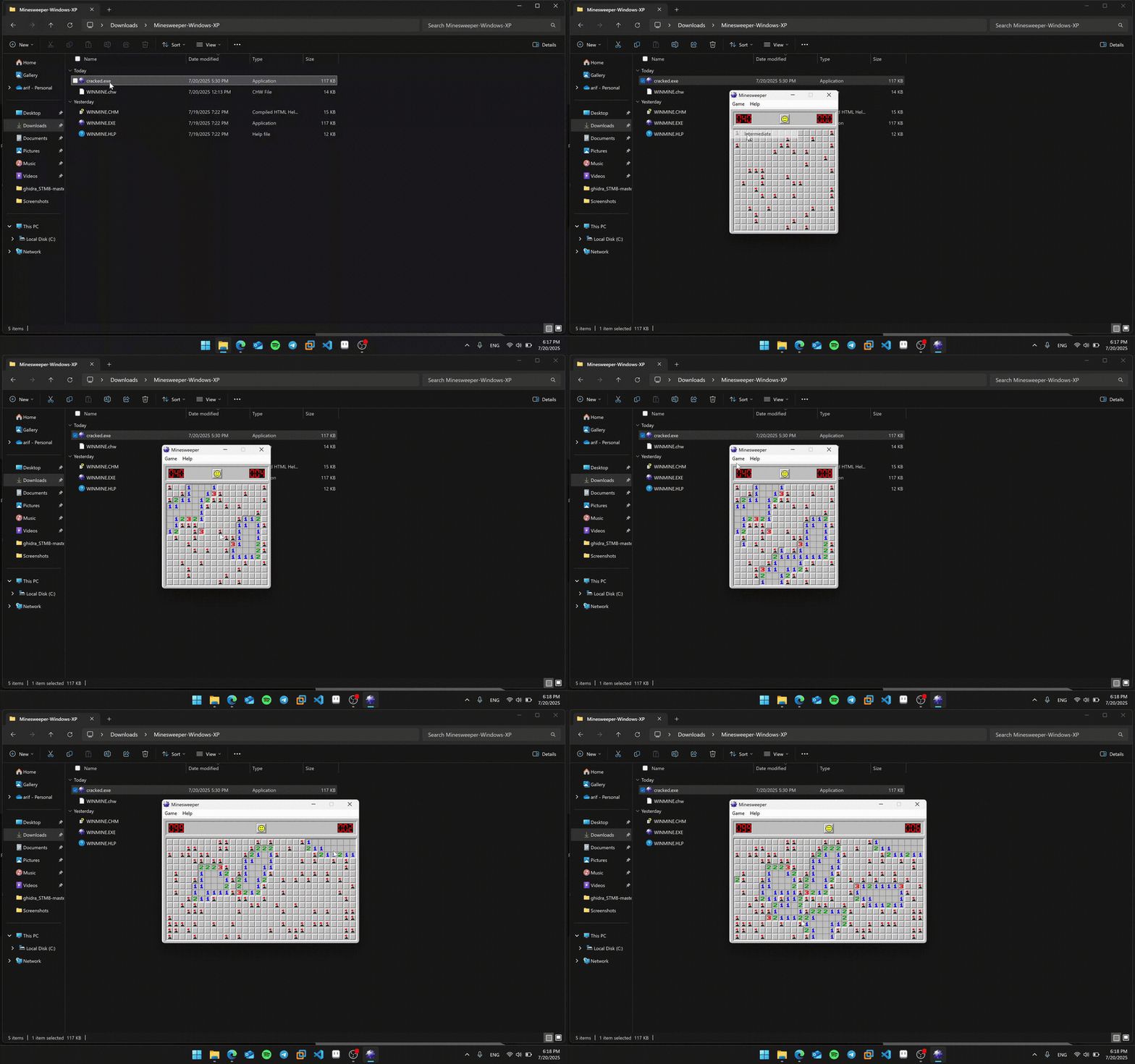
At this point I can win the game easily, but still, I am lazy to look for the memory dump each time. Let’ s patch this game so that it will be easier for me to just win. For patching idea, there was one researcher who decided to just convert 0x8f’s to the 0x8e. This will mean that when we open the game, we will see the mines flagged already. Let’s do this.
We know that OR operation converts 0x0f to 0x8f right?
After struggling and using chatgpt, i found that if we XOR 0x0f with 0x81, we will get 0x8e. To do this just make this change as a patch in x32dbg:
010036FA | or byte ptr ds:[eax],80 --> xor byte ptr ds:[eax],81
This is the result:
--
cushz :: Exploit development, reverse engineering and Windows internals.
Originally published on Medium.